LeBron James: Heavy Is the Crown as The King Makes His Final Decision by Choosing the Philadelphia 76ers


We may never see another NBA player like LeBron James from the absurd expectations in high school to exceeding the hype as the only player to win Finals MVP for three different franchises on his way to winning the most games (1,236) and scoring the most points (51,961) in league history.
After weeks of speculation, The King made what should be his final decision of his career on Friday when he chose the Philadelphia 76ers as his fourth and likely last NBA team. He said retirement was a real option before deciding to return for his 24th season after agreeing to terms on a 2-year deal worth just $8M.
Even though he’s going to be 42 in December, James still moves the needle in every way from shifting the NBA odds on next year’s champion to garnering the most attention, negative or positive, for his decision to join the 76ers after an offseason filled with player movement.
The reactions were mixed as expected with some thrilled about the potential in Philly, some angry about “ring chasing” allegations, some intrigued about how the usage rates will work here, and some disappointed (Cleveland, Miami, Golden State) that he isn’t going to their team.
No matter how you view it, only LeBron can go into Year 24 with people still thinking he’s a threat to win the championship for a Philadelphia team that has not advanced past the conference semifinals since 2001. LeBron has been to the NBA Conference Finals 12 times since the 76ers’ last appearance.
We’ll get into the fit with the 76ers in our final section, but first, let’s look back at the broken discourse over NBA team building, and why James became the master of unrestricted free agency out of necessity. Remember, he has never formally requested a trade in his NBA career, and he’s won a championship with all three franchises he’s played for. Doing so with a fourth will be tough, but if anyone can do it, it’s him.
BREAKING: LeBron James is heading to the Philadelphia 76ers! 🔥
— 365Scores (@365Scores) July 24, 2026
The NBA superstar has agreed to a 2-year, $8 million contract with a player option, according to Klutch Sports CEO Rich Paul. pic.twitter.com/PbDIItDFy9
Table of Contents
Is It an NBA Superteam or a Team with Superman?
One of the strangest developments in the NBA discourse in the last decade is the outright dismissal and disgust for “superteam” building, a term that still lacks a concrete definition as I’m not sure any roster involving Bradley Beal in its Big 3 (2023-24 Phoenix Suns) should be considered a superteam.
But it becomes hypocritical when many of the same people discounting a superteam for “ring chasing” are primarily ranking players based on ring count. Is winning an NBA championship the ultimate goal or not? Make up your minds, because if it’s stats and leading your team in contention for rings over a long period of time, then someone like James with his four rings in 10 NBA Finals can absolutely lay claim to the “GOAT” title over Michael Jordan, who went 6-0 in the Finals in a very advantageous situation in the weaker 1990s.

The Myth of Ethical Team Building in the NBA
But this goes well beyond any LeBron vs. Jordan GOAT debate. This is about the fact that the idea of “ethical team building” in a league like the NBA is hogwash. The only ethical line you have to uphold is to not illegally circumvent the salary cap and pay players through other revenue streams to keep them on your roster like the Denver Broncos were caught doing in the NFL after two Super Bowl wins in 1997-98.
Was it “ethical” that young teams like the Thunder and Spurs endured multiple losing seasons to get more high draft picks to build around Shai Gilgeous-Alexander and Victor Wembanyama with blue-chip talent players like Chet Holmgren, Jalen Williams, Stephon Castle, and Dylan Harper?
We covered this idea of ethical team building during the 2026 NBA playoffs, or back when people claimed the Thunder and Spurs were going to win the next five championships. But they couldn’t even repeat between the two of them as the New York Knicks, a core built exclusively through free agency and trades with players who didn’t have a Hall of Fame trajectory, went on a historic playoff run and took down the Spurs behind Finals MVP Jalen Brunson.
The Knicks were clutch, and they showed how putting some talent around a player like Brunson with chemistry from teammates he had at Villanova (Josh Hart, Mikal Bridges) and a trade for a former No. 1 pick at center (Karl-Anthony Towns) was enough to produce a championship, ending a 53-year drought for the Knicks.
So, we can’t even prove that the “right way” to build an NBA team today is the route the Spurs and Thunder took. Don’t forget the Indiana Pacers, who did not draft Tyrese Haliburton or Pascal Siakam, were on the brink of the greatest upset in Finals history in 2025 before Haliburton tore his Achilles in the first quarter of Game 7 in Oklahoma City.
In fact, we have some evidence that it’s not the most ethical way to build a team since the NBA has already moved to new anti-tampering rules to prevent a team from dominating in the draft lottery like the Spurs did to land their Big 3 of Wemby, Castle, and Harper.
Roster Building Is Era Dependent in NBA History
Speaking of the draft lottery, that did not exist until 1985 when the New York Knicks won the grand prize of Patrick Ewing. Before that, you could luck out and trade a player to a bad team and a couple of years later, they perform so badly that you end up with the No. 1 overall pick in the draft even if you were coming off a playoff season. That’s what the Los Angeles Lakers did twice to land Magic Johnson (1979) and James Worthy (1982) with No. 1 picks to build up their Showtime Dynasty as we detailed here.
Superteams are not a new concept in the NBA, and the construction of them has depended on what rules were in place for player contracts at the time. If you wanted to acquire another team’s superstar in the 1960s-70s, you were going to have to give up players, cash considerations, and maybe multiple draft picks.
Even the best player of the 1960s (Wilt Chamberlain) and the best in the 1970s (Kareem Abdul-Jabbar) were both traded. Twice in Wilt’s case, including a trade to the Lakers where Jerry West and Elgin Baylor just couldn’t beat Bill Russell’s Celtics (join the club). Chamberlain eventually helped West win his only title in 1972, but only after Russell had been retired for a couple of seasons.

The NBA didn’t institute a salary cap until the 1984-85 season when it was a $3.6 million limit. But even back then, some owners were able to argue for a “soft” cap where a team like Boston could pay Larry Bird so much money to keep him on the team even if it put Boston over the cap limit. This became known as the “Larry Bird Exception” and smart teams like Boston used it to make sure they kept their best players from hitting free agency.
Unrestricted free agency as we know it today didn’t truly start until 1988 when Tom Chambers was allowed to sign with the highest bidder, which turned out to be the Phoenix Suns. In his first year with the Suns, Chambers helped a team go from 28-54 to 55-27. With Chambers as a starter over the next four seasons (1989-92), the Suns were No. 2 in points scored and had the fifth-highest winning percentage (.662) in the NBA.
But they only got to the Conference Finals twice and couldn’t break through to the NBA Finals. They needed that final piece to get them over the hump, which they got in the 1992-93 season when Charles Barkley got his trade from Philadelphia to Phoenix and won MVP, leading the Suns to the NBA Finals where they lost to Chicago.
It was similar to when the Toronto Raptors had the fourth-most wins in the NBA in 2015-18 but needed that uber talent (Kawhi Leonard) to put them over the top for a championship in 2019 for coach Nick Nurse, the new coach for LeBron in Philadelphia.
Why am I on a tangent about that era of the Suns and Barkley going from Philly to Phoenix? Because it highlights our final part of this first section.
The LeBron Double Standard with Superteams
Charles Barkley is a Hall of Famer and an entertaining analyst on TV. But as one of the best players to never win a ring, he can have some funky opinions on players who have them, and sometimes he just flat out gets it wrong like he did the last week when talking about James. In talking to Stephen A. Smith, Barkley repeatedly noted that LeBron has “always stacked his teams” in Miami, Cleveland (the return), LA, and now Philadelphia.
Barkley then tried to argue him going to Phoenix didn’t count because they weren’t stacked, and that he was traded to Houston when he teamed up with Hakeem Olajuwon and Clyde Drexler just two seasons removed from a Houston repeat in the 1996-97 season. Two years later, Drexler was replaced by Scottie Pippen from the Buls for another last hurrah shot at a ring.

Really, those don’t count as superteams, Chuck? That first year in Houston, the Rockets were 57-25 and lost in Game 6 of the Western Conference Finals to Utah. They were also 31-19 in that shortened season with Pippen before getting crushed in the first round by the Lakers.
It just seems odd that Barkley doesn’t view teams like Phoenix (four straight seasons with 53-55 wins, great scoring numbers) and Houston (recent repeat and multiple HOF teammates) as superteams, but he considers these superteams for LeBron:
- The Miami Heat were 0-3 in the first round of the playoffs in the four years before LeBron joined them, had a 15-67 season in 2007-08, and Chris Bosh was 0-2 in playoff series in seven seasons with Toronto. LeBron led them to four straight Finals, going 2-2 in them. After James left, the Heat missed the playoffs (37-45) in 2014-15 and won one playoff series in the next five seasons before losing to LeBron’s Lakers in the Finals in 2020.
- In the four years when LeBron was gone from Cleveland (2011-14), the Cavaliers had the worst record in the NBA at 97-215 (.311). When James returned, he led the team to four straight NBA Finals, winning in Year 2 (2016). When he left Cleveland again, they missed the playoffs four years in a row and won just 60 games in the first three years combined in 2019-21.
- When James joined the Lakers in 2018, they had missed the playoffs five years in a row in the worst stretch in franchise history and were also last in the NBA with a 126-284 (.307) record. He won them the title in his second season.
- Even the 76ers were just the No. 7 seed last year, needed a 3-1 comeback against a Boston team that didn’t have Jayson Tatum for Game 7, then were swept by the Knicks. Joel Embiid is going on 33 and rarely healthy, and the 76ers haven’t been past the second round since 2001.
If Barkley didn’t join stacked teams, then neither did LeBron.
Isn’t it odd that LeBron gets criticized for “ring chasing” on stacked teams just because he’s one of the only players who actually makes his teams into champions?
There have been no shortage of special team-ups in the last decade, and many largely failed, especially the ones involving players like Kevin Durant (Nets with Kyrie Irving and James Harden, Suns with Devin Booker and Bradley Bal), James Harden (Nets, 76ers with Embiid, Clippers with Kawhi Leonard, Cavaliers with Donovan Mitchell), and Paul George was involved in a lot of those too.
There’s not great evidence that superteams lead to NBA Finals appearances, let alone championships in an era that would be defined by supermax contracts. The most successful person at moving to new teams and winning championships was James with four titles in nine seasons for the Heat (2012-13), Cavaliers (2016), and Lakers (2020). Each time he was the best player on those teams as well, an important distinction to make.
In fact, the only two moves that can compare had a direct impact on James’ decisions to join new teams:
- Paul Pierce was going to request a trade from Boston unless they got him stars, and that’s why they acquired Kevin Garnett and Ray Allen in 2007, leading to a ring in 2008. That team also eliminated James’ Cavaliers in the playoffs twice in 2008 and 2010, exposing the flaws in Cleveland’s one-man show roster. Thus, James left for Miami in 2010.
- After James had a healthy Kyrie Irving and Kevin Love that he lacked in the 2015 Finals, he overcame a 3-1 deficit to take down Golden State in 2016. Instead of getting an even rubber match in 2017, the 73-9 Warriors stacked the deck by adding Kevin Durant to their team, and they dominated Cleveland in the next two Finals before injuries derailed them in the 2019 Finals against Toronto.
Not only are NBA superteams not new, but James didn’t invent them. He just did it better than anyone.
The Cavaliers Wasted Seven Years of LeBron’s Career
LeBron James gave the Cleveland Cavaliers seven seasons after they made him the No. 1 pick in the 2003 draft, then continued to put very little around him in that time. That’s longer than No. 1 overall picks Kareem Abdul-Jabbar (six years on the Bucks) and Shaquille O’Neal (four years on the Magic) stayed with their original teams before both joined the Lakers.
When you look at what Cleveland was doing to James in his age 19-25 seasons, he would have been foolish not to leave that situation.
The Luxury Cleveland 1.0 Did Not Afford LeBron James in Seven Years
In James’ first seven NBA seasons, he led the Cavaliers every season in points, assists, and steals on a per-game basis. He was also one of the team’s better rebounders and their second-best shot blocker after Zydrunas Ilgauskas. Between his dominance and longevity, one of James’ greatest strengths has always been his versatility. He made averaging 25 points/6 rebounds/6 assists look so routine that he did it in 16 seasons, double the amount of his next closest competitor (Oscar Robertson).
But one of James’ greatest strengths has also been a weakness for how his teams perform around him. So often, he has been the team’s best scorer, best passer/playmaker, and also expected to be one of the best rebounders and defenders on a nightly basis. The most responsibility and biggest workload you can put on a player, and he’s usually succeeded in that role, which is why he’s been in the GOAT conversation so long.

But most players aren’t asked to play that way. Nikola Jokic in Denver and Luka Doncic on his two tams have been two of the only contemporaries who can relate to this situation. When Michael Jordan was in Chicago, he eventually had a player like Scottie Pippen come along and handle a lot of the “point-forward” responsibilities that James has taken on in his career. Jordan could just focus on scoring. James had to score a lot and do the other stuff.
However, since most people agree scoring is the hardest thing to do and the most important to winning games, this is an area where Cleveland shockingly let James down in his first run with the team.
In his first seven seasons in Cleveland (2003-04 through 2009-10), LeBron never had a teammate average 18.0 points per game in a season with him. He had at least one such teammate in 15 of his next 16 seasons (only exception was 2017-18 when Kevin Love was No. 2 on Cleveland with 17.6 points per game).
The closest was when Mo Williams averaged 17.8 points per game in the 2008-09 seasons, his first in Cleveland. The same year where Williams averaged 16.3 points per game in the playoffs and shot .408 from the field (down from .467 in the regular season). The same postseason that James had the highest Game Score (29.3 vs. Orlando) in any Conference Finals by a player since 1984.
On the surface, you might not see the big deal about a player averaging 18.0 points per game in a season. But that’s exactly the point. It’s not a special number, and most teams are able to get multiple players to average that in a season. If you’re a lover of round numbers, you probably want to see 20-point scorers, and I grabbed that research too.
I researched 500 NBA players who played the majority of their career after the shot clock was introduced for the 1954-55 season. This list includes Hall of Famers, MVPs, All-NBA players, the top 250 players in Player Efficiency Rating (PER), Rookie of the Year winners, players with multiple seasons averaging 20 points per game, etc.
LeBron James is the only player on this list of 500 players who didn’t have a teammate average 18.0 points per game until his 8th season in the NBA. The only one here.
You can click through the tweet image to see the list of players who achieved this in their first NBA season, but we’ll show the table with the season and team for the players who did it in Year 2 or later.
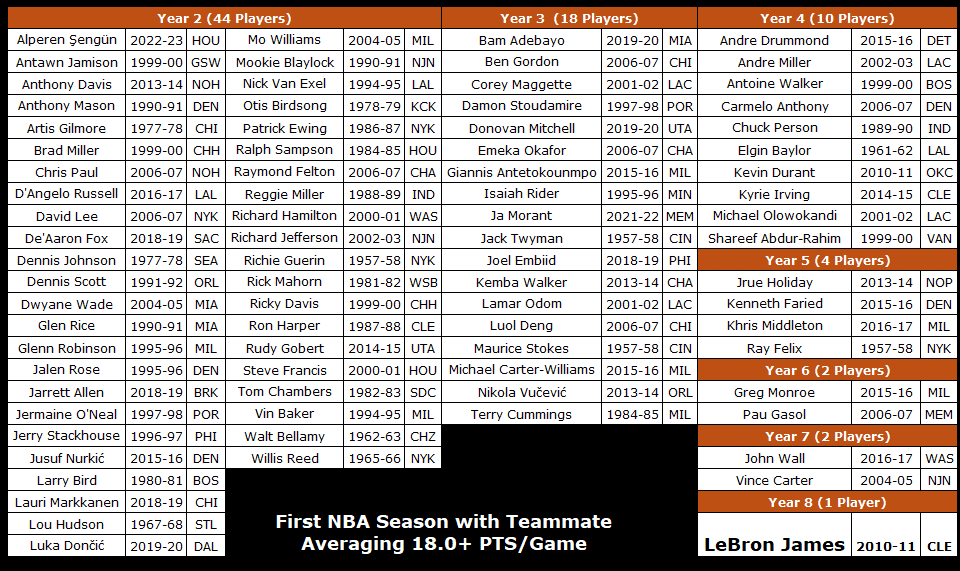
- A whopping 419 of these players (83.8%) had an 18-point teammate in their very first NBA season.
- Some of these players had two, three, or even four teammates average 18.0 points per game in a season early in their careers.
- Only 37 players (7.4%) had to wait until Year 3 or later for an 18-point scorer.
- Only 5 players (1.0%) had to wait until Year 6 or later, and the only players close to LeBron at 7 years each were Vince Carter and John Wall.
- It’s probably not a coincidence that Vince Carter was just 1-2 in playoff series with Toronto when he was traded to the Nets in his 7th season, or that Wall never got Washington past the second round, and he didn’t average 20.0 points per game himself until Year 7 in the league.
If you expand the number to 20.0 points per game, then James is joined in Year 8 by Isaiah Rider and Kenneth Faried. He’s surpassed by Damon Stoudamire lasting until Year 9, though he just missed it in Year 3 in Portland when Rider averaged 19.7 points per game. Then the two players with the longest waits for a 20-point scorer were Year 10 for Ben Gordon (Bulls and Bobcats) and Nikola Vucevic (a lot of Orlando years).
But just asking for 18 points isn’t a lot, and the Cavaliers could not do it for all seven years with James. Historically weak scoring support, and it’s not like he had multiple guys averaging 17.5 points for him. Even if you remove any minimum game qualifiers, James had just two Cleveland teammates average 16.0 points per game, and they were four years apart in 2004-05 Ilgauskas (16.9) and 2008-09 Mo Williams (17.8).
The Lack of NBA Draft Help for LeBron James
In addition to the lack of scoring around James in Cleveland the first time around, that stint started a career-long trend of little value being added to his rosters from the NBA draft, which is only two rounds deep. But it has provided some excellent, career-changing value for most stars of the past and present.
In fact, you could easily make the case that LeBron has received the least amount of help through the NBA draft than any superstar in league history.
Even when you account for James leaving his teams and some of his team’s picks being used in trades to acquire players like Kevin Love, Anthony Davis, and Luka Doncic, the actual players picked just don’t or wouldn’t have moved the needle.
After Cleveland made James the No. 1 pick in 2003, here are the next 30 players his teams drafted, including picks in years he joined the team where he technically joined in July after the June draft in each instance, including Miami (2010), Cleveland (2014), Los Angeles (2018), and Philadelphia (2026).
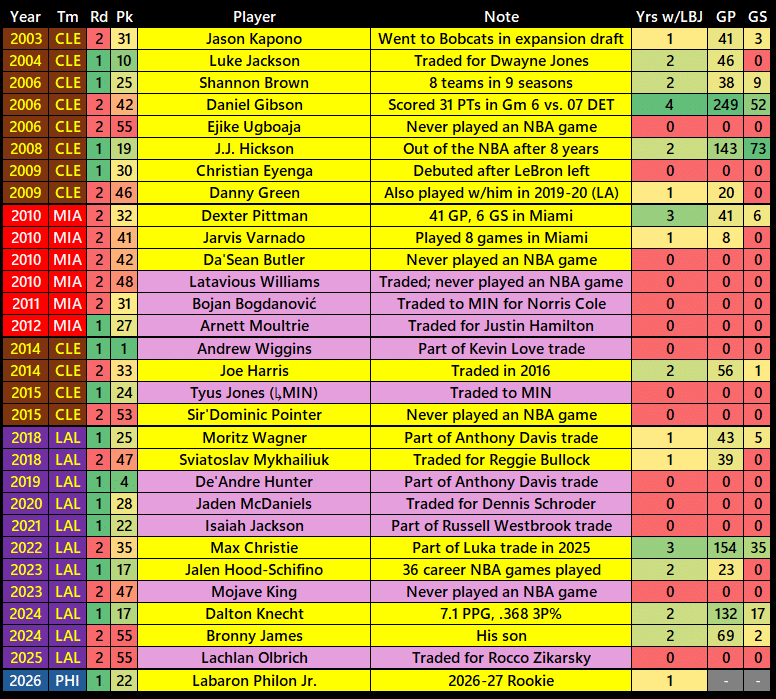
Note: The GP and GS represent how many games played and games started (regular season only) the player played for James’ teams as his teammate. It does not include how many games the player actually played with James active that day.
You know things are rough when his son Bronny is fifth in games played (69) here, or that Daniel Gibson (of 2007 Game 6 vs. Detroit fame) was the most useful teammate LeBron ever had drafted.
But what does one do when you start making the playoffs in Year 3, so you avoid getting lottery picks to get the best talent at the top of the draft. You’re basically limited to free agents and trades, and the Cavaliers didn’t do a great job of building around James the first time at all.
Meanwhile, if you look at what other legends got out of the draft, there’s no comparison. Of course some of them never left their situation. Why would they?
- Michael Jordan: The Chicago dynasty was built in the 1987 draft after the Bulls drafted Horace Grant at No. 10 and acquired No. 5 Scottie Pippen in a draft-day trade.
- Kareem Abdul-Jabbar: He wasn’t getting to the NBA Finals with the Lakers until they landed Magic Johnson with the No. 1 pick in 1979, then won another coin toss to get James Worthy with the No. 1 pick in 1982.
- Tim Duncan: Started his career playing with David Robinson, the Spurs’ No. 1 pick in 1987, then the team had some late-round gems like Tony Parker (1.28 in 2001) and Manu Ginobili (2.57 in 1999). Also acquired Kawhi Leonard in a draft-day trade in 2011.
- Shaquille O’Neal: Magic were lucky to get the top pick again in 1993 draft, which they turned into a trade for Anfernee “Penny” Hardaway, then Shaq played for the Lakers at his peak after they acquired Kobe Bryant in a draft-day trade in 1996.
- Steph Curry: Warriors drafted Klay Thompson (1.11 in 2011) and Draymond Green (2.35 in 2012) to build their championship core, which turned into a dynasty once you added Kevin Durant in free agency in 2016.
- Bill Russell: Came into the league with Boston draft picks Tom Heinsohn and K.C. Jones after he was acquired in a trade with St. Louis on draft day, then the Celtics drafted Sam Jones in 1957 (1.8) and John Havlicek in 1962 (1.9) as two of his greatest teammates on the way to 11 rings.
- Larry Bird: The Celtics drafted Kevin McHale with the No. 3 pick in 1980, traded for Robert Parish with another high draft pick, and would have kept adding to a great core if not for the tragic early passings of Len Bias (1986 top pick) and Reggie Lewis (1987 top pick).
- Kevin Durant: He got rewarded for bad records early in his career after the move from Seattle to Oklahoma City with high picks Russell Westbrook (1.4 in 2008) and James Harden (1.3 in 2009).
- Hakeem Olajuwon: He wasn’t drafted any HOFers in Houston to win with, but he got useful pieces out of the draft in Robert Horry (1.11 in 1992) and Sam Cassel (1.24 in 1993), who were on the repeat teams in 1994-95. He also started his career with Ralph Sampson, the Rookie of the Year who went No. 1 overall to Houston a year before Olajuwon joined forces with him.
- Wilt Chamberlain: He was drafted to a Warriors team that had HOFer and 2-time scoring champ Paul Arizin still on the roster as well as future HOFer Tom Gola. Later added Nate Thurmond (1.3 in 1963) and then Billy Cunningham (1.7 in 1965) when he was on the 76ers.
James just never had those pieces added to his teams, so his job was to help players who hadn’t won anything before like Bosh, Love, Irving, etc. win at the highest level. Even Anthony Davis was only 1-2 in playoff series in seven seasons as the Alpha in New Orleans before he joined James in Los Angeles.
LeBron going to three different teams and still being the best player and winning a championship is a truly 1-of-1 performance in NBA history that others could only hope to emulate if they had the chance. Several stars had the chance too as players like Shaq (six teams) and Durant (five teams) have played for more teams than James has in the NBA.
What to Expect from LeBron James in Philadelphia?

The Philadelphia 76ers were already going to be one of the most interesting teams from an analytical standpoint in the 2026-27 season after the big trade for Jaylen Brown from Boston, swapping out Paul George for the Celtics’ veteran who has an odd history of solid traditional stats and poor on/off splits in Net Rating.
Now you add LeBron James to the mix, and I can only chuckle at the Batman reference here for Brown’s role:
After the 2026 NBA Finals ended, the 76ers were +6000 to win the championship next season. They moved up to +1800 after acquiring Brown from the Celtics, and they are +1000 today after the James signing, the fourth-best championship odds at FanDuel.
But with James, Brown, Joel Embiid, Tyrese Maxey, and second-year guard VJ Edgecombe, you have a fascinating mixture of players who had a combined usage rate of 142% last season over their three teams. Yikes.
That is a lot for coach Nick Nurse to manage. He figured it out in his first year in Toronto when he took over as head coach of the Raptors in 2018 after being promoted from assistant. They had a really solid roster and basically just swapped DeMar DeRozan for Kawhi Leonard and won the title.
He’s got a much harder job here as you have to figure out roles for two new forwards who are deep into their career and used to doing things a certain way. You always have to work around Embiid’s health, and you have to make sure you’re not stunting the development for Edgecombe, who might be the answer to who they go to for shots in the clutch as he performed well in those moments as a rookie (15-of-24, 62.5% FG%, when tied or behind in the last 5:00 of a close game).
They’re going to have to figure it out, and an overlooked reason for why so many superteams have failed is because of health. The Nets just couldn’t get Durant, Harden, and Kyrie on the court together for any real amount of time before one left injured. Then Leonard and Paul George with the Clippers were often injured, Durant had injuries in Phoenix, and Beal was injured too there.
But the 76ers have something here, and don’t forget the added depth like Anfernee Simons and Dean Wade. I can see why James picked this team over Cleveland where you just don’t want to spend your final games stuck with James Harden, the Kiss of Death in the postseason.
The fit in Miami also wasn’t great at all after the Heat gave up a ton of shooting to get Giannis Antetokounmpo paired with Bam Adebayo. Adding LeBron wouldn’t help that outside shooting problem, so I can see why he didn’t return there either. I never believed he should have been going to play with Steph Curry in Golden State, a team that should remain his nemesis.
Philadelphia it was, and you can see the vision with a healthy Embiid at center not having to exert as much scoring, and the outside shooting from Maxey and Edgecombe. Brown could also work on his defense more after trying to keep up the scoring pace without Tatum for most of last season.
This starting five is one of the most unique experiments in NBA history, and I can’t wait to see how it plays out. Philadelphia was not the logical storybook ending to James’ NBA career, but he never needed to be defined by the city he plays for. His legacy is playing at the highest level no matter where he goes and who he does it with. He’s basically had four Hall of Fame careers in one.
Father Time might not allow this to be a fifth, but the fact that he still generates this much attention and respect in Year 24 is a testament to his greatness. Enjoy it while it lasts because we’re not going to see another do it like this.
Related Articles:
- Ranking Every NBA Team’s All-Time Starting 5: Can Anyone Prevent Lakers vs. Celtics?
- 2026 NBA Draft Recap: Wizards Take AJ Dybantsa, Big Night for Michigan, and Spurs-Thunder Rivalry Heats Up
- The 3 Types of Great Players in Team Sports: Savior, Emperor, and General (SEG)
- Why the New York Knicks Prove Clutch Is Real, How the Spurs Can Win the 2027 NBA Finals, and the Offseason Storylines to Watch
- The Greatest NBA Finals Comebacks of All Time: The Knicks’ 29-Point Triumph in Game 4 Sets a New Standard
- 2026 NBA Finals Game 3 and MVP Picks: Do the Young Spurs Still Have a Shot After Blowing Both Home Games?
- 2026 NBA Finals Preview and Game 1 Picks: Are the Knicks or Spurs the Team of Destiny?
- Thunder and Avalanche Go Out with a Whimper in 2026: Is Point Differential a Good Way to Predict Champions?
- Is 2026 Finally the Year for the New York Knicks to Rule the NBA?
- Building an NBA Champion: Are the Spurs and Thunder the Right Blueprint for the 2020s?
- 2026 NBA Conference Finals Preview: Let the Epic Spurs vs. Thunder Rivalry Begin
- 2026 NBA Conference Semifinals Preview: The Inevitable West vs. Unpredictable East
- 2026 NBA Playoffs Preview and NBA Finals Odds: Do the Thunder Repeat?
- 2026 NBA Awards: Why Is SGA the MVP Favorite? Which Duke Great Deserves Rookie of the Year?
- The Most Unbreakable NBA Records: Does Bam Adebayo’s 83-Point Game Make Us Reconsider Wilt Chamberlain’s 100-Point Game as the Toughest?
- 2026 NBA Finals Odds Update at the All-Star Break: Thunder Still the Team to Beat?
- 2025-26 NBA Season Preview: Top Storylines and Best Bets for NBA Finals and Player Awards
- Top Storylines to Follow in the NBA This Summer: Will the Thunder Finally End the Repeat Drought in 2026?
- The 10 Greatest NBA Conference Finals Series of All Time and Picks for Pacers-Knicks Game 5
- 2025 NBA Western Conference Finals Preview: How Can the Timberwolves Stop the Thunder?
- NBA Playoffs: Are More NBA Star Players Injured Than Ever Before?