The Swedish Fairytale: A Village Team of 800, with a Coach Who Was a School Principal, on the Brink of a Historic Title

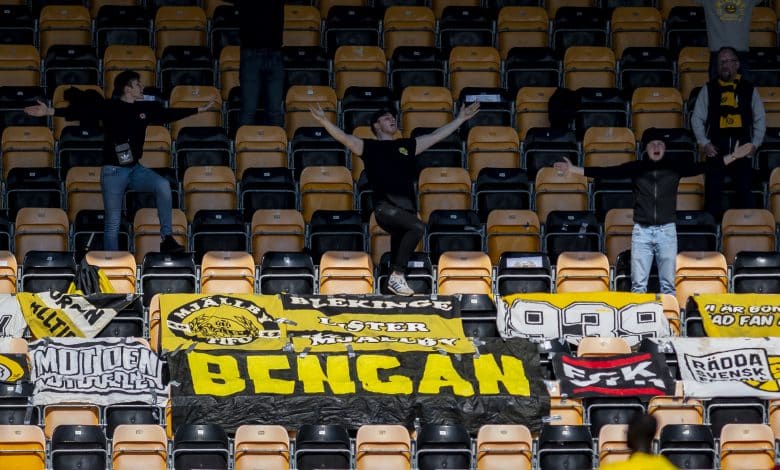
With a stadium on the shores of the Baltic Sea, a fishing village of fewer than a thousand people is watching its local team challenge the giants of Swedish football for the championship.
In a football world increasingly dominated by financial powerhouses, a true fairytale is coming to life in Sweden. It could culminate in a historic achievement for a modest team from a fishing village of fewer than a thousand inhabitants in the south of the country, with a stadium on the Baltic coast and a coach who, until recently, was a school principal. The little-known Mjällby AIF, based in Hällevik, could become Swedish champions for the first time in its history this Saturday (4th) when they face Elfsborg.
The journey captivates football lovers and carries a dose of drama. Ten years ago, the team, founded on April 1, 1939, was one game away from relegation to the fourth division and on the verge of bankruptcy.
David vs. Goliath, or the “Swedish Leicester”
For outsiders unfamiliar with Mjällby’s story, it’s natural to look for a similar campaign, an analogy. And it’s impossible not to recall and compare this potential (probable?) Swedish feat with Leicester City‘s English title in 2016. An underdog never included in the list of favorites, who ended up conquering the billionaire-fueled and highly competitive Premier League.

“Some said that Leicester was practically destined to be relegated. And we thought, ‘Okay, the experts say we’ll finish mid-table.’ You have to understand that we come from a village of only 800 inhabitants and are practically the only team from the region in the first division,” said CEO Jacob Lennartsson, in an exclusive interview with Lucas Dantas for 365Scores Brazil.
“Compared to the big clubs, we are inexperienced and have much less money. Theoretically, our success shouldn’t be possible, but it’s a David vs. Goliath story. No one truly believes in a team that’s so small in so many ways, but at the moment, we are the best in Sweden in terms of winning games.”
A Stadium in the Middle of Nowhere
Hällevik, where Mjällby is based, has a population of just over 800 residents. The village is located in the historic province of Blekinge, which has 70,000 inhabitants but is in an isolated region. On the shores of the Baltic Sea, the Strandvallen Stadium averages six thousand fans per game – nearly eight times the local population. The difference is explained by the massive support on match days. People travel from larger cities in the region, such as Sölvesborg, Kristianstad, and Karlsson, to watch the local club.
The arrival at the stadium can feel like the “end of the world,” a point of complaint for visiting clubs. Despite agreeing with its isolated position, the CEO believes it is “fantastically located.”
“It’s something strong in our culture. You drive for 10, 12 minutes in the middle of nowhere. Just when you think the world is about to end, the arena appears,” he assessed. “The most important thought is: when you arrive here, you feel at home, it’s lovely. We have a family feeling, and the opponents who leave here leave with zero points (laughs). And I think we have been dealing with all of that very well now.”
For the small community, the potential Swedish championship means a great deal. But Jacob Lennartsson points out that the passion for football in the village has always been present – whether in the third division or now as the best team in the country, “people have always loved Mjällby.”
“I just hope that now, as we compete for the biggest trophy in Sweden, they are very proud and happy, because they have also had years of sadness and frustration.”
Record-Breaking Points
Mjällby leads the Swedish league with 60 points, 11 ahead of the runner-up, Hammarby, with five rounds to go. The title could be secured with a victory over Elfsborg this Saturday at home, and if Hammarby stumbles in their away game on Sunday.
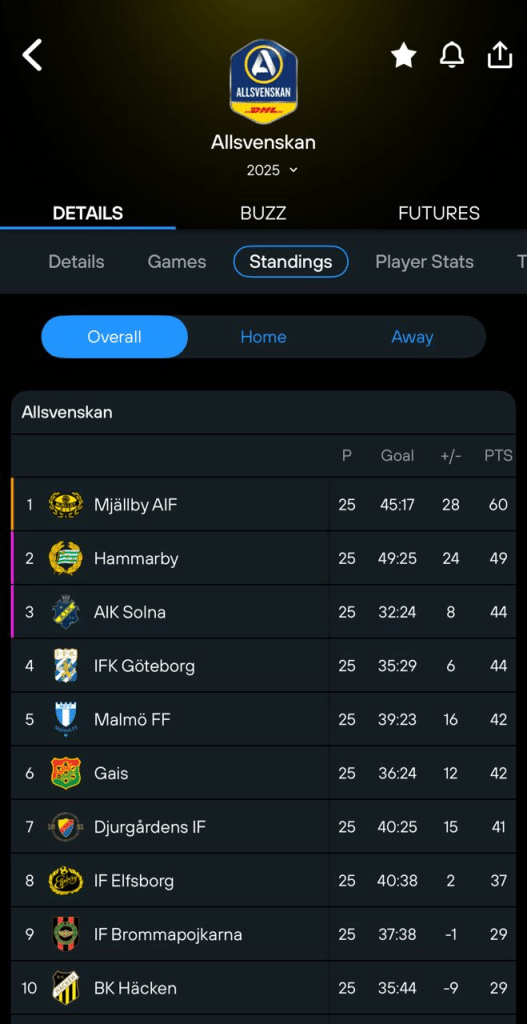
The small team from the fishing village could also break the all-time points record in Sweden, currently held by Malmö with 67 points, achieved in 2010.
“Mjällby has always been a small club. When we first reached the top division in 1980, nobody thought it was possible. In 2023, we went to the final of the Swedish Cup. Nobody believed Mjällby could be in a Cup final, but we made it,” Lennartsson recalls.
“We hope with everything we have that 2025 will be the year Mjällby wins the Allsvenskan (the first division). You go from a vision that’s impossible to achieve to a goal that’s really difficult to achieve. But it is possible, and that gives us hope.”
The Coach Who Was a School Principal
The 2026/27 season could mark the small club’s debut in the Champions League. Already qualified for a European competition, the team, managed since 2023 by coach Anders Torstensson, needs to lift the trophy to enter the Champions League qualifiers.
Torstensson is in his third stint as Mjällby’s manager and has a peculiar and curious story: when he wasn’t working in football, he was a school principal.
When he was re-hired two years ago, the main point noted by the board was that Torstensson was a “man of structure,” someone who understood the local identity.
The leap in visibility is described as “very intense” by Jacob and will bring its own problems. With a potential Champions League spot, UEFA is not expected to allow matches to be played at the modest Strandvallen Stadium. This would force Mjällby to find a new home to attempt to reach the league phase.
How to Compete with Limited Resources?
Swedish football has a rule that prevents majority investors in clubs. This makes it difficult for small teams to compete with traditional powerhouses like Malmö, AIK, and Djurgårdens. Mjällby’s great secret to survival rests on two pillars: cost discipline and player sales.
Even with a healthy economic situation, the club adopts the philosophy that while it can’t be the best at making money, it can be the best at not spending it. The goal is to be more efficient with every Swedish krona spent, creating a “low-cost Mjällby.”
According to the specialized website Transfermarkt, Mjällby’s entire squad is valued at €16.85 million. For context, Barcelona‘s Lamine Yamal alone is valued by the same site at €200 million.

“To succeed on the field, you need to be successful economically. The structure was made to be very clear about the fact that Mjällby could not cost more than the money we knew we were bringing in,” says Jacob Lennartsson.
The club understood it needed to be firm about the guaranteed money from ticket sales. From that amount, Mjällby would define its costs, so even if everything went wrong, they would already have clarity on which players they could sign.
This intelligent investment is directed towards their biggest source of revenue: the transfer of valuable assets. In this regard, the scouting department sees it as crucial to discover new talents that fit the philosophy before the big clubs do. With this, it’s possible to develop the young player with the good structure provided by the institution and without external pressure, maximizing their potential for a future sale.
To identify the best names, the scouting department builds a squad strategy to maintain standards. The first rules are to ensure the team’s average age is below 25, and that at least five players from the youth categories are ready to be sold. There’s also a ban on having two players in the same position with contracts expiring in the same year, a rule that 25% of the squad must be from the academy, and that only two loan signings can be made.
A Promise to Run Naked…
While dreaming of the unprecedented title, Jacob Lennartsson is beginning to live with a slight, but welcome, anxiety. In case of a trophy, the Mjällby CEO will have to fulfill an unusual promise made to his son: to run naked through the neighborhood.
“After we were promoted to the first division in 2020, my son started asking me: ‘Dad, what will you do if we win the Allsvenskan?’ And I always said: ‘I promise you I will run naked through the neighborhood.'”
“I thought it was an easy promise to make, but now I’m starting to scout out what kind of bushes and trees I can hide behind. I’m regretting it a little bit,” he joked.