In a modern NBA increasingly defined by floor spacing, analytical efficiency, and rigid disciplinary fines, the era of the “enforcer” has largely become a thing of the past. Fighting is a dying art in a league where “holding each other back” is usually just a choreographed dance to avoid a suspension. However, last night’s chaotic clash between the Detroit Pistons and Charlotte Hornets felt like a glitch in that polished system. When Jalen Duren and Moussa Diabate tangled, sparking a melee that saw Isaiah Stewart and Miles Bridges trade punches and ejections, it provided a reminder of the league’s rowdier roots. While the brawl was the most unpredictable moment of the 2026 season, it is still minor in comparison to the the top five NBA fights. From the fan-involved terror of the Malice at the Palace to the bone-shattering punch of Kermit Washington on Rudy Tomjanovich. We may never see the days of the 1990s Knicks-Bulls wars again, but for one night in Charlotte, the ghosts of the “Bad Boys” seemed to haunt the hardwood once more.
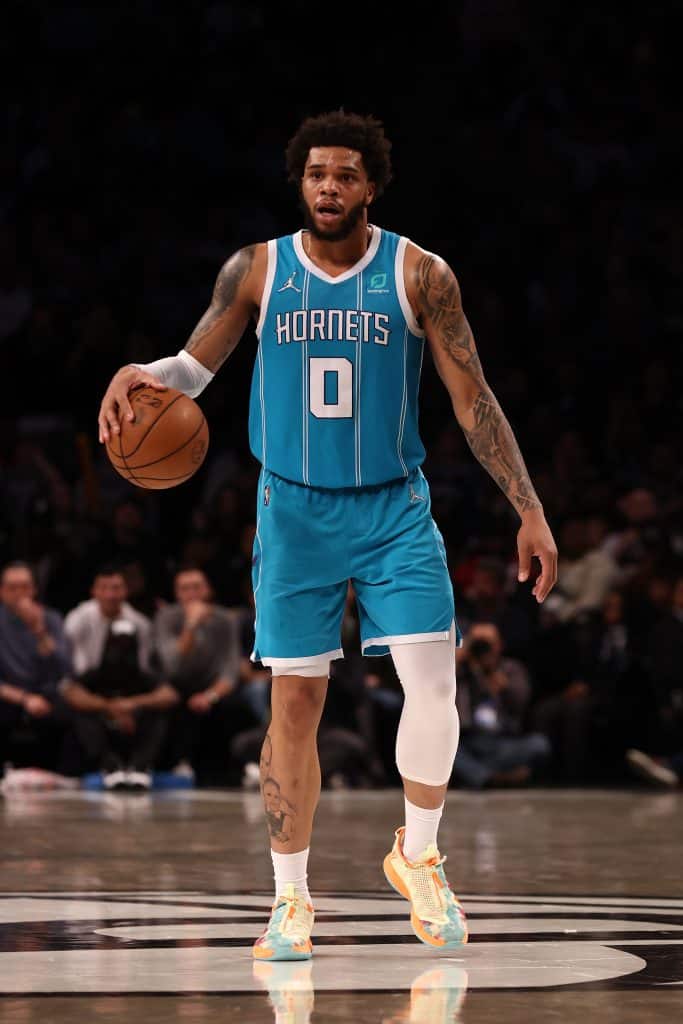
Table of Contents
What happened?
With 7 minutes left in the third quarter during the matchup on February 9, 2026, between the Detroit Pistons and Charlotte Hornets, an altercation that felt more like a 90s rivalry than a modern matchup occurred. It wasn’t just a brief scuffle; it was a multi-player brawl that required a brief police presence on the floor to restore order. Detroit’s All Star Center Jalen Duren war driving hard to the basket when he was met with a hard foul by Charlotte’s Moussa Diabaté. The two immediately went chest-to-chest, butting heads and exchanging words. Duren then escalated things by striking Diabaté in the face with an open right hand.
As teammates ran into the middle to break up the fight, things only escalated from there. While Tobias Harris was trying to restrain Diabaté, Diabaté threw a punch at Duren. Hornets forward Miles Bridges then charged into the mess, throwing a left-handed punch at Duren. Duren fired back with a punch of his own. Seeing his teammate outnumbered, Isaiah Stewart (who was on the bench at the time) sprinted onto the court. In a scene reminiscent of his infamous pursuit of LeBron James years ago, Stewart aggressively engaged Bridges, eventually getting him in a headlock and delivering multiple blows before being peeled away by security.
The officiating crew, led by John Goble, spent nearly ten minutes reviewing the footage. The results were decisive: Four players were tossed: Jalen Duren and Isaiah Stewart for Detroit, and Moussa Diabaté and Miles Bridges for Charlotte. The tension didn’t end there. In the fourth quarter, Hornets coach Charles Lee was also ejected after he had to be physically restrained by Brandon Miller while screaming at officials over a separate no-call.
Despite the brawl, the Pistons held on to win 110–104, snapping Charlotte’s nine-game winning streak. Given Stewart’s history and the fact that he left the bench to join the fight, the league office is expected to hand down significant suspensions by the end of the week.
From Hardwood to Haymakers: Measuring the Charlotte and Detroit Chaos Against the NBA’s Most Infamous Wars
Looking into the biggest fights in NBA history, it is hard to not compare what happened last night to them. To truly understand the weight of last night’s Spectrum Center melee, we have to look beyond the immediate box score and place it on the ranking system against the most explosive moments in league history. In the following sections, we will dissect how the Pistons-Hornets scrap measures up to each of the NBA’s “Top 5” historic fights, using them as benchmarks for violence, consequence, and cultural impact. Using a 3 category system to compare each fight, the categories are: The Trigger: Was it a basketball play gone wrong or a personal vendetta? The Scale: Did it stay between two players, or did it involve benches and fans? And lastly, The “Hammer”: How did the league discipline each event?
The Malice at the Palace: When the Hardwood Became a Riot
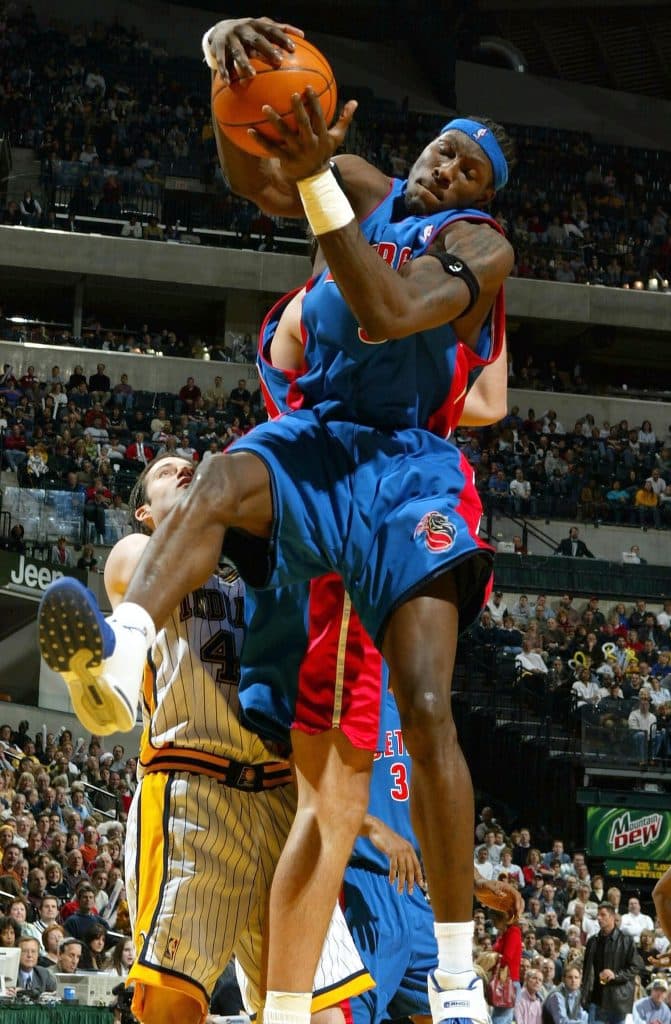
The “Malice at the Palace” remains the most explosive and culturally damaging event in NBA history, a dark Friday night in November 2004 that permanently changed the traditional boundaries between players and spectators. What began as a chippy, late-game shove during the Pistons and Pacers game between Ben Wallace and Ron Artest (now Metta Sandiford-Artest) escalated into a terrifying scene. After Artest retreated to the scorer’s table to de-escalate, a fan threw a cup of Diet Coke that struck him in the chest, prompting Artest to charge into the stands. The resulting chaos saw players like Stephen Jackson and Jermaine O’Neal trading blows with fans both in the seats and on the court. It was a moment of pure chaos that forced the NBA to fundamentally rewrite its security protocols and its relationship with the public.
The Comparison: Malice at the Palace vs. Pistons-Hornets
- The Trigger: Unlike the Duren-Diabaté foul, which was a standard “hard play” escalation, the Malice was triggered by a fan’s intervention. While last night was a player-vs-player conflict, the 2004 brawl was a player-vs-fan catastrophe.
- The Scale: While the Pistons-Hornets fight involved several ejections and a headlock, it remained contained to the hardwood. The Malice was a multi-front riot involving the stands, the court, and the tunnels, requiring dozens of police officers to restore order.
- The “Hammer”: The discipline for the Malice was historic, totaling 146 games in suspensions. The suspensions for the Pacers players looked like this: Ron Artest 86 games (rest of season and playoffs), Stephen Jackson 30 games, Jermaine O’Neal 15 games (originally 25 games but appealed and won), Anthony Johnson 5, and Reggie Miller 1 game. On the other side, Pistons players received heavy, yet shorter suspensions as well: Ben Wallace 6 games, Chauncey Billups 1 game, Derrick Coleman 1 game, and Elden Campbell 1 game. Even if Isaiah Stewart receives a lengthy “repeat offender” penalty for last night’s actions, it will likely be less than 10% of the total time lost in 2004.
“The Punch”: The Shot That Nearly Killed a Career
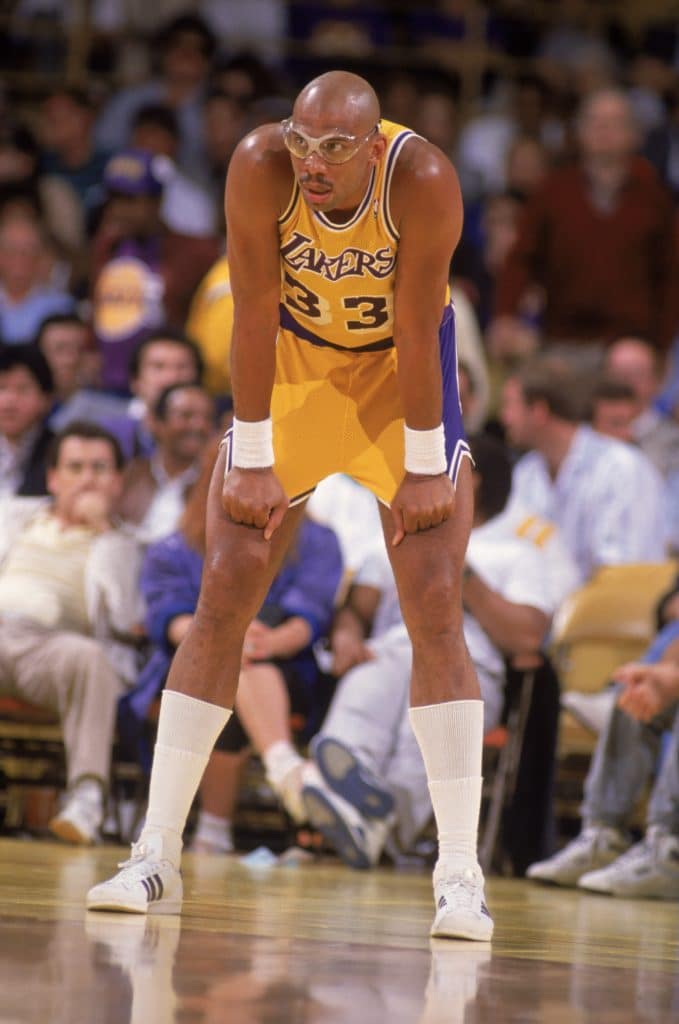
While last night’s scuffle featured some heavy breathing and a headlock, it carries none of the life-threatening weight of December 9, 1977. In a game between the Lakers and Rockets, a mid-court skirmish broke out between several players. Rudy Tomjanovich, running toward the fray to act as a peacemaker, was met by a blindside right hook from Lakers enforcer Kermit Washington. The force was so catastrophic that it shattered Tomjanovich’s face, dislodged his skull, and caused spinal fluid to leak into his mouth. The sound of the impact was famously described by Kareem Abdul-Jabbar as a “watermelon being dropped on concrete.” This single blow nearly killed Tomjanovich and forced the NBA to realize that its “Enforcer Era”, where fighting was essentially part of the game’s marketing, had to end for the sake of survival.
The Comparison: “The Punch” vs. Pistons-Hornets
- The Trigger: In both cases, the victim was technically a involved member in the brawl. Rudy Tomjanovich ran in to de-escalate, much like Isaiah Stewart entered the fray last night. However, while Washington struck a peacemaker out of a perceived threat, Stewart entered specifically to hunt a confrontation.
- The Scale: Both incidents were limited to the players on the court, but the severity of the damage is worlds apart. Last night was a high-intensity scrap; 1977 was a medical emergency that required five reconstructive surgeries and changed the trajectory of two lives forever.
- The “Hammer”: Washington was fined $10,000 and suspended for 60 days (26 games), which was the largest punishment in NBA history at that time. Today, a 26-game suspension is a massive ban, but considering the near-fatal nature of the 1977 injury, Washington’s punishment was actually quite lenient by 2026 standards.
The Knicks-Nuggets Melee (2006): The Garden’s Track Meet
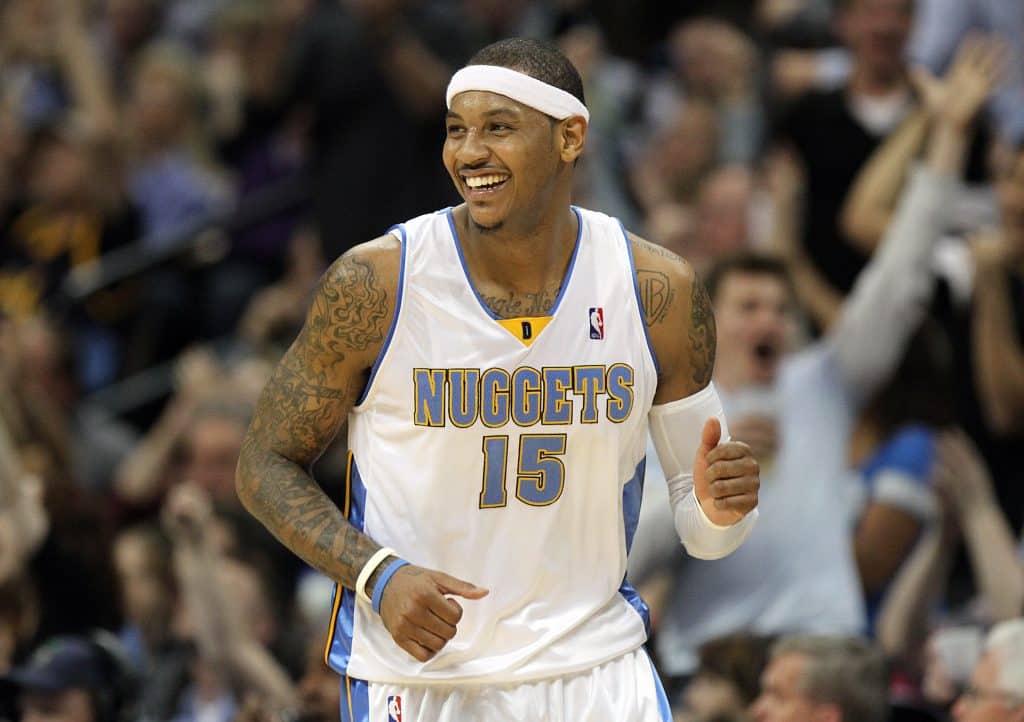
The 2006 Knicks-Nuggets brawl at Madison Square Garden was a chaotic reminder that tension often boils over when a team feels disrespected on their home floor. With just over a minute left in a Denver blowout, Knicks guard Mardy Collins delivered a hard, neck-high flagrant foul on J.R. Smith to prevent a breakaway dunk. The situation instantly turned from a basketball game into a wrestling match as Smith and Nate Robinson tumbled into the front row. However, the most iconic and debated moment came when Carmelo Anthony, the league’s leading scorer at the time, landed a sucker punch on Collins before immediately backpedaling to his own bench. The image of Melo retreating while Jared Jeffries sprinted across the court in pursuit became the defining visual of the melee, resulting in ten ejections and a massive crackdown from Commissioner David Stern.
The Comparison: Knicks-Nuggets vs. Pistons-Hornets
- The Trigger: Both fights were sparked by “unnecessary” physical play of a game. Much like Moussa Diabaté’s hard foul on Jalen Duren last night, Mardy Collins’ foul was a clear message that the losing team wasn’t going to be “showed up” anymore.
- The Scale: The 2006 brawl was significantly larger in scope, involving all ten players on the floor being ejected and the fight physically spilling into the photographer’s area. Last night’s scuffle was localized to a few key participants, though Isaiah Stewart’s sprint from the bench mirrored Jared Jeffries’ 2006 dash in its intensity.
- The “Hammer”: The discipline in 2006 was staggering for an on-court incident: seven players were suspended for a combined 47 games. The suspensions on the Knicks included: Nate Robinson 10 games, Mardy Collins 6 games, Jared Jeffries 4 games, and Jerome James 1 game. On the Nuggets: Carmelo Anthony 15 games, J.R. Smith 10 games, and Nene 1 If the NBA applies this same “Garden Standard” to last night, Isaiah Stewart’s headlock on Miles Bridges could easily land him a double-digit suspension.
Dr. J vs. Larry Bird (1984): The Clash of the Icons
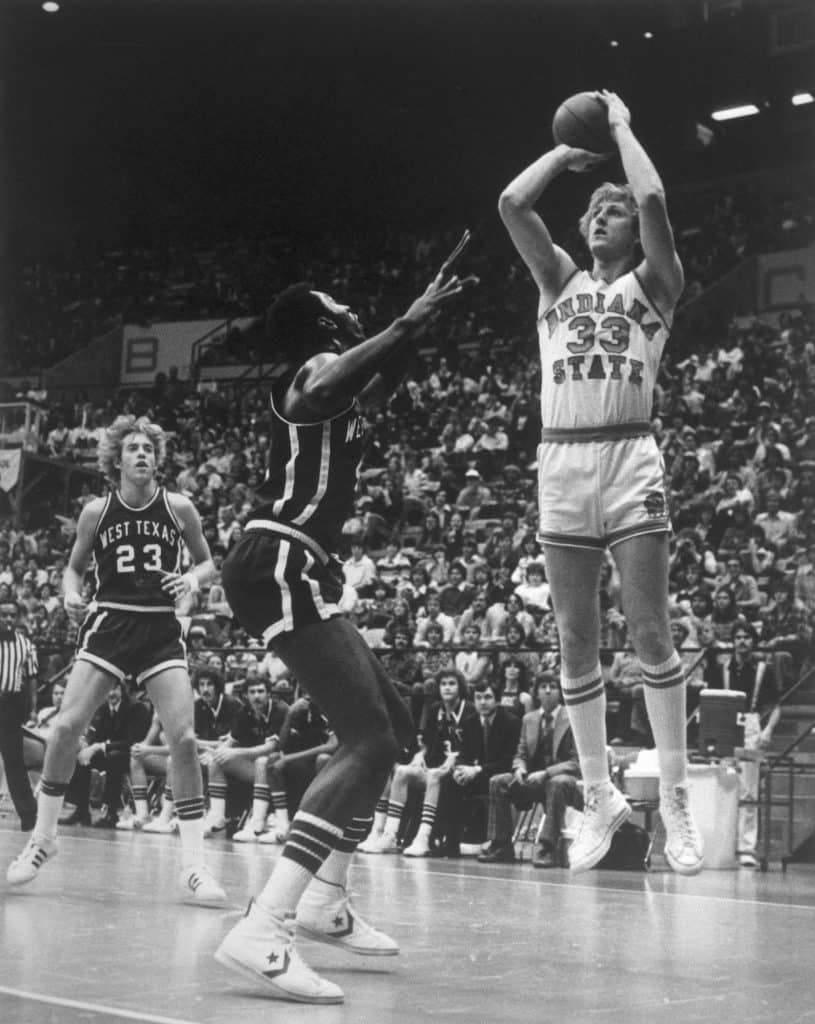
The 1984 showdown between Julius Erving and Larry Bird remains the most star-studded fistfight in NBA history, proving that even the league’s ultimate ambassadors weren’t immune to a boiling point. During a heated November matchup at the Boston Garden between the Boston Celtics and Philadelphia 76ers, Bird, who was in the midst of a 42-point masterclass, reportedly relentlessly trash-talked Erving, who had managed only 6 points. The frustration led to the two legends grabbing each other by the throat. In a chaotic sequence, a rookie Charles Barkley and veteran Moses Malone restrained Bird, which inadvertently allowed Dr. J to land three clear punches to Bird’s face. Despite the spectacle of the league’s two biggest stars trading haymakers on national television, the fallout was a product of a much different era of sports discipline.
The Comparison: Dr. J/Bird vs. Pistons-Hornets
- The Trigger: Both incidents were fueled by “disrespect”. Just as Moussa Diabaté and Jalen Duren clashed over a hard foul during a momentum shift last night, Erving’s fuse was lit by Bird’s legendary “retire already” trash talk while the Celtics were leading by nearly 20 points.
- The Scale: While last night’s fight was a multi-man scuffle, it was largely a “young man’s game.” The 1984 fight was a heavyweight bout involving three Hall of Famers (Bird, Erving, and Malone) and a future Hall of Famer in Barkley. The cultural shock of seeing the “Doctor” and “The Legend” brawl far outweighs the local intensity of last night’s Pistons-Hornets melee.
- The “Hammer”: This is the most shocking difference. In 1984, the NBA issued zero suspensions. Bird and Erving were simply fined $7,500 each, the second-highest fine at the time, but a far cry from a ban. If Isaiah Stewart or Miles Bridges expect that same “superstar leniency” for last night’s headlocks and punches, they are in for a rude awakening from the modern league office.
Knicks vs. Heat (1998): The “Human Anchor” Brawl
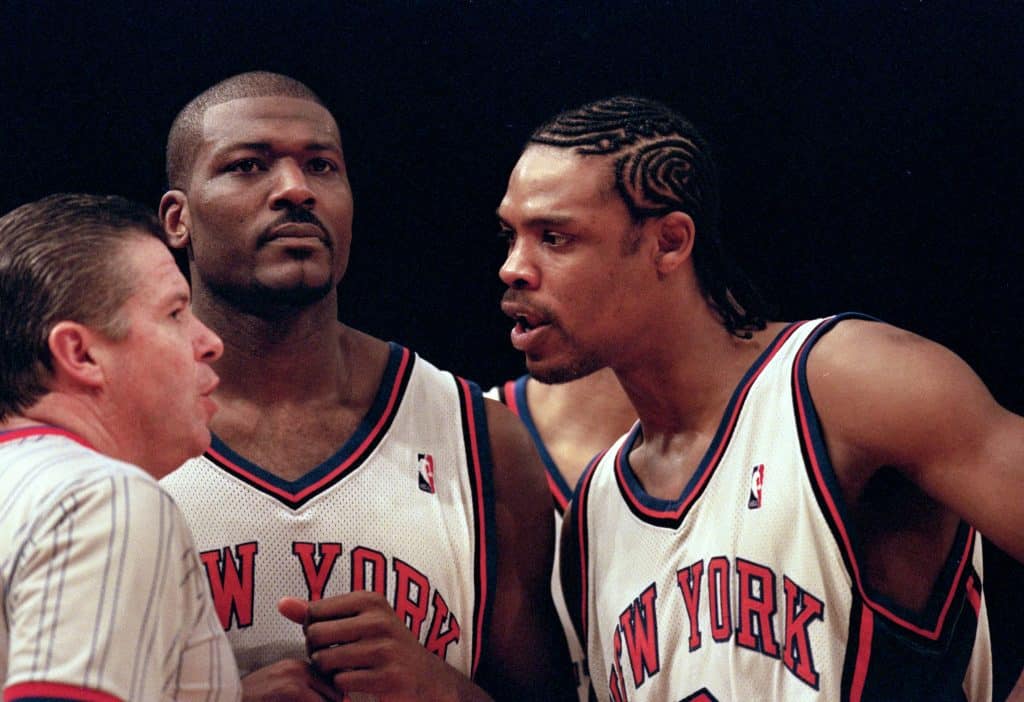
The final historic showdown on our list is the legendary 1998 playoff clash between the New York Knicks and Miami Heat—a rivalry so physical it felt like a four-year-long wrestling match. In the closing seconds of Game 4, former teammates Alonzo Mourning and Larry Johnson got tangled up and began trading wild, albeit mostly missed, haymakers. The moment was immortalized not by the punches, but by Knicks head coach Jeff Van Gundy, who sprinted onto the court and desperately clung to Mourning’s leg in an attempt to stop the fight. Van Gundy was dragged across the hardwood like a “piece of gum on a shoe,” providing an image of coach-led intervention that remains the funniest, yet most desperate, peacemaking attempt in sports history.
The Comparison: Knicks-Heat vs. Pistons-Hornets
- The Trigger: Both fights were the result of “boiled-over” tensions from physical play throughout the game. Much like last night’s scuffle between Jalen Duren and Moussa Diabaté, the 1998 brawl started with a simple battle for rebounding position that turned personal due to the players’ shared history and the high stakes of the game.
- The Scale: While the 1998 fight featured a head coach on the floor, last night’s incident actually had a higher volume of active combatants. The involvement of Isaiah Stewart entering from the bench and Miles Bridges charging in created a more chaotic, multi-directional threat than the one-on-one “boxing match” between Mourning and Johnson.
- The “Hammer”: In 1998, the NBA issued two-game suspensions and fines to both Mourning and Johnson ($20,000 and $10,000, respectively). Interestingly, Chris Mills was suspended for one game just for leaving the bench. If the league follows the 1998 blueprint, the “punches thrown” by the Pistons and Hornets last night will result in much lighter sentences than the 15-game ban seen in 2006, though Stewart’s bench-leaving antics likely push him toward the higher end of the scale.
The Disciplinary Hammer: What Awaits the Pistons and Hornets
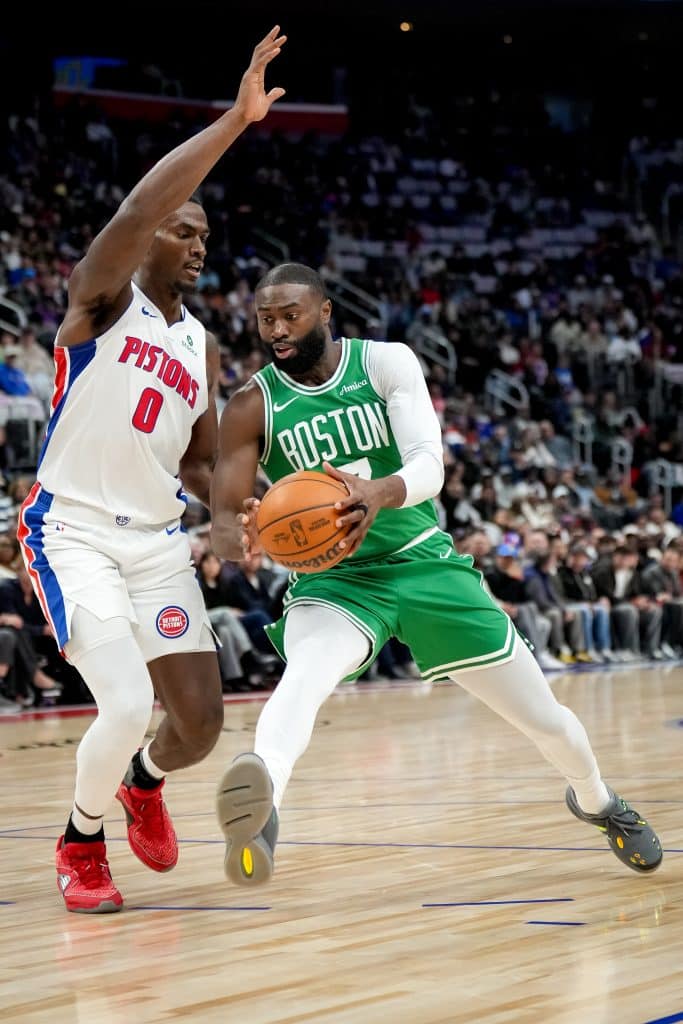
While the dust has settled at the Spectrum Center, the real fallout is just beginning as the NBA’s league office reviews the tape of last night’s melee. History tells us that Commissioner Adam Silver and Joe Dumars, the league’s “Discipline Czar”, rarely show leniency in the modern era, especially when players leave the bench. For Jalen Duren and Moussa Diabaté, the instigators of the initial shove, the precedent of the Knicks-Nuggets (2006) suggests a suspension in the 3-to-5 game range. However, the focus is squarely on Isaiah Stewart and Miles Bridges. Stewart’s “repeat offender” status bolstered by his infamous 2021 pursuit of LeBron James and his 2024 parking lot altercation with Drew Eubanks means he could be looking at a 10-to-15 game ban, particularly for entering the fray from the bench and engaging in a headlock. Bridges, who threw clear punches during the escalation, faces a similarly steep climb. In an NBA that has spent twenty years distancing itself from the “Malice at the Palace” image, this disciplinary wave is likely to be the largest the league has seen in over a decade, sending a stern reminder that the “Bad Boy” era is strictly for the history books.