All Roads End Here: Indiana vs Miami National Championship Preview

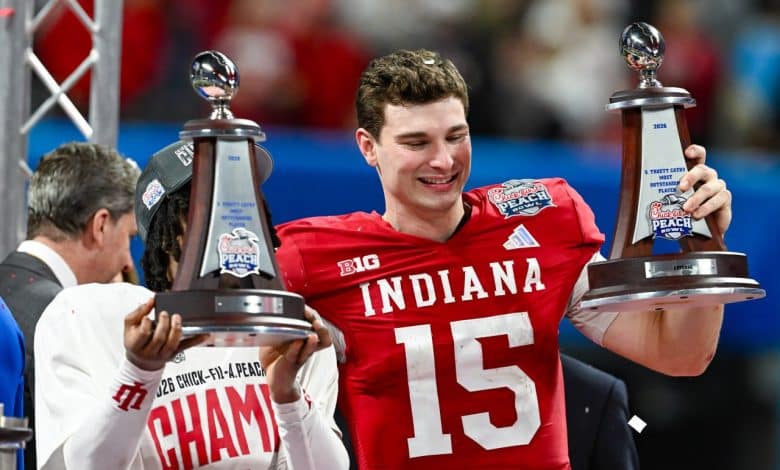
Under the lights at Hard Rock Stadium on Monday night, the 2026 College Football Playoff National Championship has a matchup nobody penciled in back in August: No. 1 Indiana vs No. 10 Miami, with a title on the line in Miami Gardens. Indiana arrives riding a postseason demolition job, flattening Alabama and Oregon by a combined 94 points and powered by Heisman winner Fernando Mendoza, playing with the swagger of a team that thinks destiny is real.
Miami has made a habit of surviving the ugliest kind of games, slipping past Texas A&M, Ohio State and Ole Miss, and now gets the rarest possible advantage: a championship game in its own backyard. It’s the ultimate clash of styles, Indiana’s explosive control versus Miami’s gritty and physical style of football. It sets up a night where the first couple of hits, the first big throw, and the first mistake could decide who finishes the season holding the trophy. With two organisations that in recent years have been starved of success, we’re set for a matchup that will define legacies. One fanbase will erupt, and the other will have their hearts broken.
Table of Contents
Road To The National Championship
Indiana
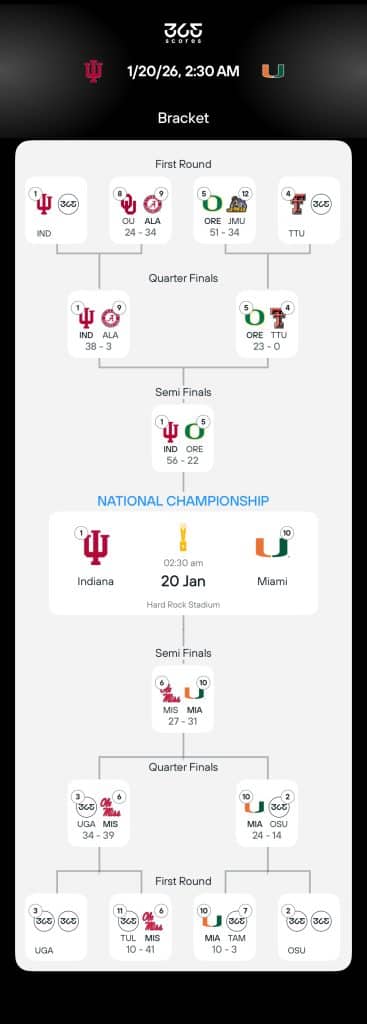
Indiana’s path has felt less like a Cinderella story and more like a team removing all doubt, one opponent at a time. Led by Head Coach Curt Cignetti, the Hoosiers tore through a perfect regular season, then validated it on a neutral-field stage by beating Ohio State 13–10 in the Big Ten Championship. They then entered the playoff as the top seed and backed it up immediately in the Rose Bowl quarterfinal, flattening Alabama 38-3 and never letting the game breathe. A week later in the Peach Bowl semifinal, they did the same thing to Oregon, jumping ahead early, leading from the first play of scrimmage with a pick-six from star DB D’Angelo Ponds and cruising to a 56-22 win that looked like a mismatch by halftime. Mendoza had control for all 4 quarters, passing for 5 TDs and leaving no doubt and now gets a chance to play for a National Championship against the University of Miami, whose campus is just 1 and a half miles from his childhood home.
The story is headlined by Heisman winner Fernando Mendoza, who has played the postseason like it is a controlled scrimmage: in the Oregon game, he completed 17 of 20 passes, and through two playoff games, he had more touchdown passes (8) than incompletions (5). But Indiana’s defining trait has been the violence and discipline up front. Since the Big Ten championship win over Ohio State, Indiana has erased opposing run games and hunted quarterbacks, holding Ohio State, Alabama and Oregon to a combined 174 rushing yards (2.5 per carry). The result is a team that arrives in Miami with the rarest kind of confidence: it has not just won, it has controlled every type of matchup the bracket could throw at it.
Miami
Miami’s road has been the long route, the kind that forges a team in close games and makes it comfortable living on the edge. The Hurricanes entered the playoff as the No. 10 seed (13–2) and had a a lot of controversy about its selection over Notre Dame, but owned their opportunity and immediately played their style in the first round: a 10–3 win over No. 7 Texas A&M that stayed tight until the final minutes, when Malachi Toney finally broke it with an 11-yard touchdown catch late in the fourth quarter. They carried that same gritty identity into the quarterfinal and took down No. 2 Ohio State 24–14, a result that confirmed Miami’s defence travels and that they are happy turning games into a trench fight. Then came the moment that stamped the run into history.
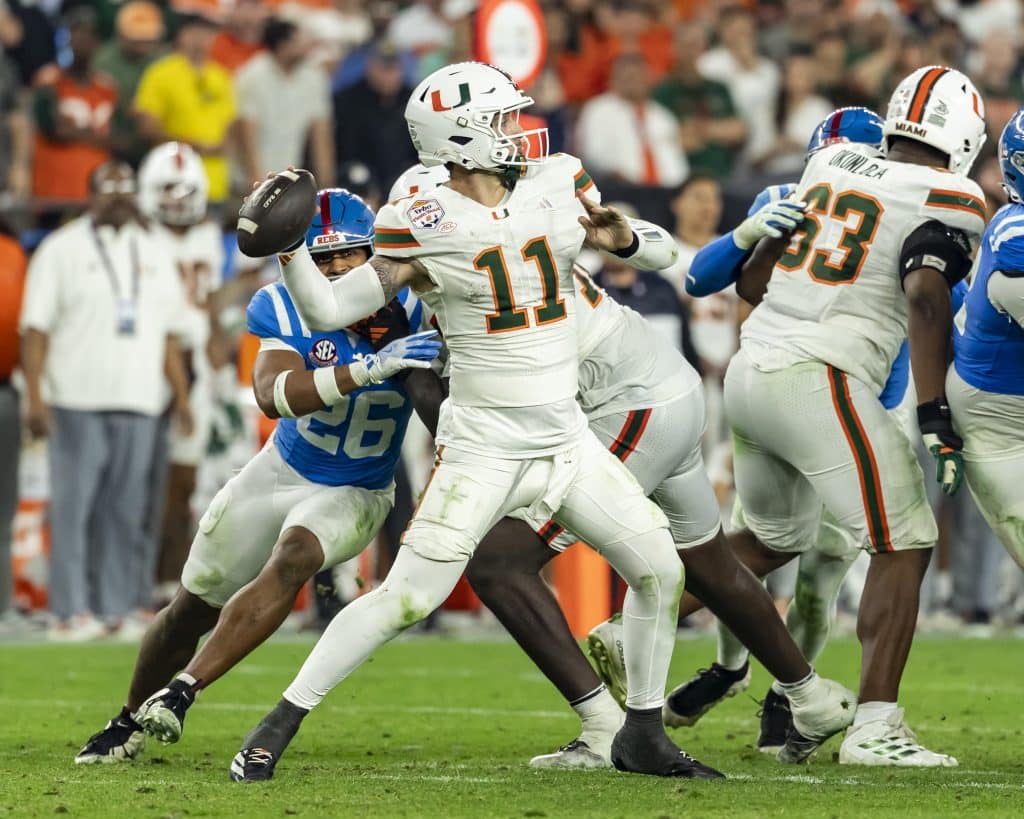
In the Fiesta Bowl semifinal, Miami edged Ole Miss 31–27 when Carson Beck authored a late, must-have 15 -play, match-winning drive and finished it himself, scrambling for a 3-yard touchdown with 18 seconds left to win it. Beck’s stat line (268 passing yards, two passing touchdowns) captures how Miami has survived, not always clean, but always fearless when the game asks for one more conversion. Throughout the playoffs, Miami has stuck to its formula: win up front, generate pressure, and run the ball well enough to keep the offense in manageable situations. Miami will enter this game as heavy underdogs, but they will be ready for a dogfight and completely willing to do it the hard way.
QB Battle: Mendoza vs Beck
This national title game is also a study in two quarterbacks who win in different ways. Fernando Mendoza has piloted Indiana’s run like a surgeon, punishing coverage with quick decisions and ruthless efficiency, and his semifinal against Oregon was the cleanest snapshot of it: 17-for-20 for 177 yards and five touchdown passes as Indiana turned the game into a rout before it ever got tense. Carson Beck, on the other hand, has made Miami a fourth-quarter problem. He has been at his best when the game tightens, and the margin disappears, and the semifinal against Ole Miss became his calling card: 268 passing yards, two passing touchdowns, then the decisive moment when he used his legs and sprinted in for the go-ahead 3-yard touchdown with 18 seconds left.
The chess match is about what each defense can force. Miami’s best chance is to make Mendoza hold the ball for an extra beat and turn Indiana’s smooth rhythm into a series of uncomfortable downs, because Indiana looks unbeatable when Mendoza is operating on schedule. Indiana’s counter is to keep Beck from living in manageable third downs and late-drive mode, because Miami has shown it can survive ugly stretches as long as Beck gets one clean chance to finish the game at the end. However it plays out, the quarterback who dictates the terms, Mendoza with control or Beck with chaos-proof composure, is the one most likely to walk off holding the trophy.
The Keys To Victory
Miami’s Pass Rush Has To Flip The Script
Miami’s best upset path starts with pressure. The Hurricanes are top-10 nationally in both pressure rate (41.7%) and sack rate (8.1%), and they have done it largely without needing to blitz. The spearhead is edge duo Rueben Bain Jr. and Akheem Mesidor. Bain is expected to be a first-round pick in the NFL Draft this year, has 8.5 sacks and 13.0 tackles for loss this season, plus a forced fumble and even an interception, which shows how often he is around the ball when plays break down. Mesidor has been the finisher, posting 10.5 sacks with 15.5 tackles for loss and four forced fumbles, the kind of production that can swing a game in a single third-and-long. Inside.Justin Scott gives them another way to collapse pockets, with 6.5 tackles for loss and one sack from the interior, so Mendoza will look to step up and rely on the quick passing game to mitigate the edge heat. For Miami, it is not just “get pressure,” it is “create longer third downs than Indiana is used to and force Mendoza to drop back and allow time for their star edge rushers to get home and create turnovers, which has so rarely come by for this Indiana offense.
Indiana’s Quick Pass Game Has To Keep Mendoza On Schedule
Indiana is at its best when its offense stays smooth and controlled, because that is when it becomes very hard to disrupt. In this playoff, they have been the best team at avoiding plays that go nowhere and at keeping every new set of downs manageable, which limits Miami’s chances to create chaos with its defensive pressure.
Miami is most dangerous when it can create pressure with just its front four. But if Mendoza leans on a quick, short passing plan and gets the ball out fast, Miami has less time to get home, which can force them to send extra rushers or play more aggressively behind it. The risk is that those adjustments open more space, and Mendoza has thrived against the blitz all season.
That is why Indiana’s fast, simple passing is so important. Quick completions keep the offense moving, reduce the time Miami has to reach the quarterback, and gradually force the defense to tighten up and take more risks. For Fernando Mendoza, it becomes a game of steady decisions: take the easy yards early, keep drives alive, and then punish Miami when it starts overcommitting. If Indiana protects well and keeps that steady flow, it can take away Miami’s biggest strength and control the feel of the game.
Miami’s Run Game
Miami’s run game has to be the engine, because it is the easiest way for them to control tempo and keep this from turning into a Mendoza shootout. The Hurricanes want to live in second/ third and short, where Carson Beck can game manage, stay patient, and pick his spots instead of having to manufacture magic on every drive. That is when Miami can lean on play-action, keep the rush honest, and avoid the obvious passing downs that let Indiana’s defense tee off. Miami’s identity all year has been power football behind a strong line, with Mark Fletcher Jr. as the centerpiece. Fletcher has 1,080 rushing yards this season at 5.4 yards per carry, and he already showed what it looks like when Miami gets its preferred script in the playoff opener, ripping Texas A&M for a career-high 172 yards in a 10–3 grinder and also went for 133 yards at 6 YPC in the semi-final against Ole Miss.
If Miami can consistently win early downs on the ground, Beck can stay efficient and conservative, and the entire game shrinks into a possession battle. If Miami gets behind the sticks and starts living in third-and-long, Beck is forced into making throws. That’s against a very strong Indiana secondary that knows how to take the ball away. Miami also love to use their screen game, out of the backfield or to their wideouts, creating run after catch and forcing Indiana’s DBs to make tackles in the open field. Their best version is one where the run game does the heavy lifting, the passing game stays clean, and Beck only has to be the closer at the end, not the whole offense from the first snap.
Key Playmakers
Malachi Toney
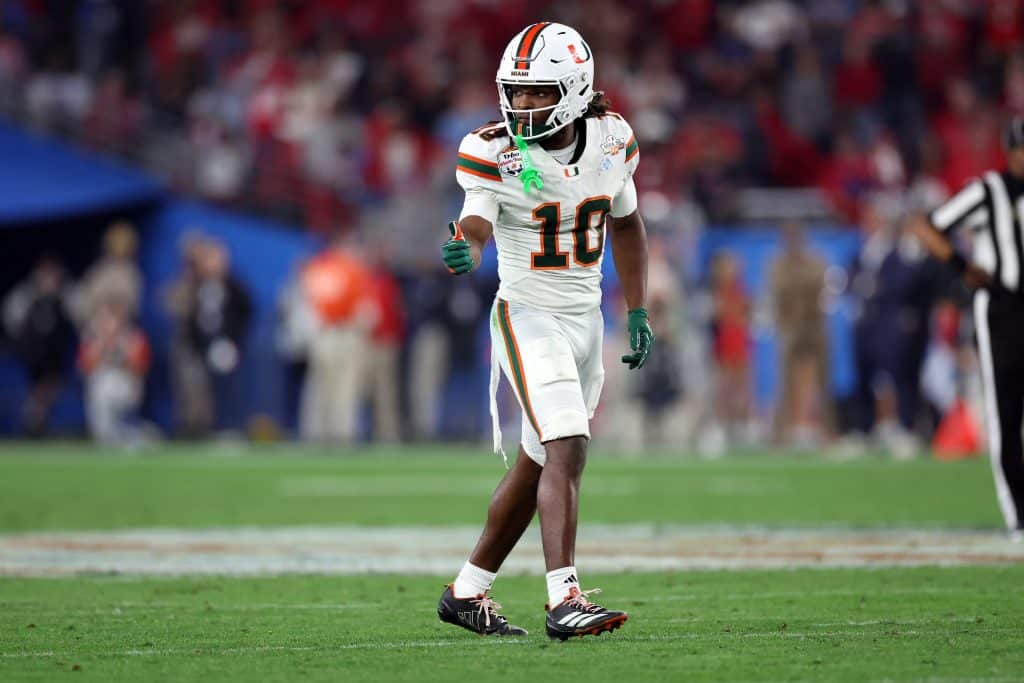
One of the most talented freshmen college has ever seen, Malachi Toney has to be more than a “big name” in this game, because he is Miami’s best chance to create explosive offense. On the season, Toney has put up true No. 1 production with 99 catches for 1,089 yards and nine touchdowns, and Miami has used him in multiple ways beyond just lining up wide. In the playoffs, he has already delivered two defining moments that show exactly why he is so important to the upset script. First, he caught the tiebreaking 11-yard touchdown against Texas A&M with under two minutes left in a 10–3 grinder, the kind of late, high-pressure play that turns a stalled offense into a win. Then in the semifinal, he took a screen pass and turned it into a 36-yard touchdown, the perfect example of how Miami can manufacture points when the pass rush and coverage are winning early in the down. Toney has delivered some huge moments in the playoffs, but ball security has been the recurring concern. He put the ball on the ground three times in the first two CFP games, so if Miami is going to win this one, he has to keep making game-changing plays without turning the ball over.
Indiana WRs
Elijah Sarratt, Omar Cooper and Charlie Becker give Indiana a receiving group that is hard to game-plan for because they can hurt you in different ways on the same drive. Sarratt has been the main finisher all season, with 62 catches for 802 yards and 15 touchdowns, which tells you how often Indiana looks for him when the field tightens and points are there to be taken. Cooper has been the steady high-volume partner and their biggest redzone threat, piling up 64 catches for 866 yards and 13 touchdowns, the type of production that keeps the offense moving even when a defense is focused on taking away the top option. Then Becker changes the geometry of the game. He only has 30 catches, but they went for 614 yards, and he averages 20.5 yards per reception, which is a huge warning sign for any defense that starts sitting on short throws too aggressively.
What makes this trio so important against Miami is that it gives Fernando Mendoza answers, no matter how the defense tries to play it. If Miami plays tighter coverage to shrink the easy completions, Indiana can punish it with Becker’s downfield threat. If Miami plays safer to avoid the big play, Sarratt and Cooper can keep stacking completions and turning long drives into touchdowns. With Sarratt and Cooper have combined for 28 receiving touchdowns, Indiana does not need “perfect” drives to score. It just needs a couple of openings, and this group is built to find them.
Defensive Stars
Miami’s defense is built around a pass rush that can wreck a game without extra help. Rueben Bain Jr. and Akheem Mesidor are the headliners, and together they have piled up 32 tackles for loss, 19 sacks from 123 pressures, 19 run stops, five forced fumbles, plus an interception and two breakups. That ability to win with just the front four is what lets Miami stay aggressive behind it, and they have more than just edge pressure. In the secondary, Keionte Scott has been the momentum-flipper in the playoff, posting three tackles for loss, two sacks and a forced fumble in the CFP, and he also had the 72-yard pick-six that swung the Ohio State game.
Indiana’s defense is defined by three playmakers who can swing a championship in one moment. Linebacker Aiden Fisher is the heartbeat, piling up 91 tackles while also impacting games beyond the box score with 3.5 sacks, a forced fumble and two interceptions, which is exactly the kind of all-around production that can disrupt Miami’s methodical approach. On the back end, D’Angelo Ponds is the tone-setter and the momentum thief, and his game-opening pick-six against Oregon in the semifinal is the perfect example of what Indiana wants defensively: strike early, flip the game, and force an opponent out of its comfort zone. Up front, Mikail Kamara is the pressure source Indiana relies on when it needs disruption, and with Stephen Daley out, his importance has only grown; in the CFP, Kamara and Daniel Ndukwe together have produced 5.5 tackles for loss, three sacks, 11 pressures and a forced fumble, the kind of havoc that heavily affect Miami’s offense and can take the National Championship away from them. Indiana has a very complete, well-rounded defense who plays very disciplined football, but also has the playmakers to swing the game, create a turnover and give their offense extra possessions.
The Head Coach Battle: Cristobal vs Cignetti
The battle of the two head coaches is one of the more intriguing storylines of this matchup. Mario Cristobal is coaching the program he once played for, a former Miami offensive lineman who was part of the Hurricanes’ national title teams in 1989 and 1991, and his football personality has always matched that background: build the roster, build the lines, make the game physical, and make the opponent prove they can handle it for four quarters. Curt Cignetti took the long route, building his résumé from Division II IUP, where he won a conference title, to a two-year run at James Madison, before arriving at Indiana in 2024 and turning it into a national power through relentless standards and veteran, mistake-proof football. Cignetti’s “aura” has become part of the show. He is famously flat on the sideline, and he has explained it as intentional, saying he cannot be seen celebrating if he wants his team to play with the same focus from the first snap to the last.
From a game-plan point of view, Cristobal’s ideal script is to make this a physical grind that stays close. That means leaning into Miami’s run-first identity, keeping the game slow, and giving Carson Beck manageable situations so he can stay efficient instead of needing to create magic on every drive. On defense, Cristobal’s biggest lever is the front, because Miami is at its best when it can win with pressure while keeping numbers back to limit big plays, forcing the quarterback to hold the ball and eventually make a mistake.
Cignetti’s approach is about removing volatility. Indiana wants to keep the offense flowing with quick decisions and steady gains, because that is how you take the teeth out of a great pass rush and stop an underdog from feeding off chaos. Defensively, Indiana wants Beck to feel every drive, to make Miami earn first downs one at a time, and to punish the one lapse with a takeaway or a sudden swing. The fun part is watching which coach gets the game they want by the middle of the second quarter, because once that happens, the rest of the night tends to follow their template.
Prediction
Indiana 21–13.
Indiana, the whole season, feels like a Cinderella story that won’t be stopped. I think Mendoza stays calm early, gets the ball out quickly, and keeps Miami’s pass rush from ever taking over. If Indiana avoids giveaways and turns a couple of long drives into touchdowns, it will control the pace, keep Beck watching from the sideline, and force Miami to play from behind and rely on Carson Beck to make big big plays with his arm and shy away from the run game. Miami can absolutely make it ugly, but Indiana’s ability to stay steady for four quarters is why I’d pick them to control the game and come home with their first National Championship in organisation history.
Bottom Line
This is the National Championship, the biggest stage college football has, where every snap feels heavier, and every mistake lasts forever. Two teams have survived the entire season for one final night, one final game, one final chance to turn an incredible run into a title. The lights are brighter, the pressure is louder, and the margin is razor-thin. This is why the sport is addictive: a stadium full of belief, a trophy waiting at the end, and 60 minutes that can rewrite legacies for players, coaches, and fanbases. Wherever you are, you won’t want to miss it because this has history-defining moments written all over it.